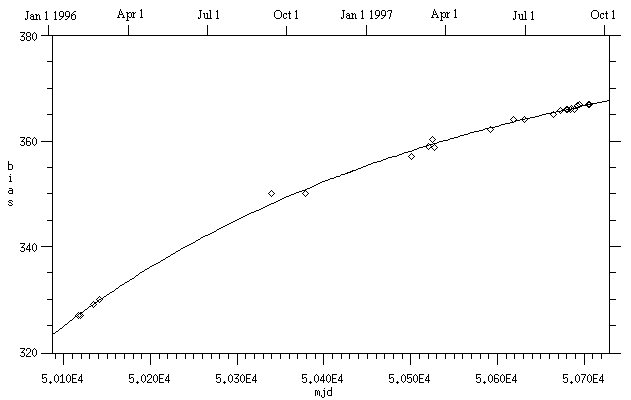
Fig. 1 - Offset Bias vs. Time
The Offset Bias
Images taken by the LASCO C1 camera have an offset bias or dark current which increases with time. The raw signal (Sr - in DN/binned pixel*) is related to the "true" signal (S - in DN/pixel/sec) by:
S = (Sr/b-f)/txwhere b is the binning (pixel/binned pixel), f is the offset bias (DN/pixel) and tx is the exposure (sec).
* NOTE - pixels may be "binned" or grouped together. These are specified by the "LEBX" and "LEBY" parameters in the header and the binning is given by b==LEBX * LEBY.
Calculation of the Offset Bias
Calculations of the LASCO C1 offset bias have been done using dark images for various days during the mission. The value of the offset bias for a particular image was taken to be the value assumed by the most number of pixels in the image. In other words, a histogram of the signal values in the image was created, and the value corresponding to the maximum of the histogram function was taken to be the offset bias for that image. This was done in order to eliminate the effect of cosmic rays. In addition, the smallest exposure times possible were used in order to minimise the effect of stray light.
A functional approximation to the offset bias as a function of time was assumed to be given by:
f = a + b*( 1 - exp(-t/t0) )where f is the offset bias, a, b, and t0 are constants, and t is the time in days from julian day 50395. That is:
t = mjd - 50395
A least squares fit of the offset bias to the above equation
yields the following values for the constants:
     a  = 351.958	DN/pixel
     b  = 30.7349	DN/pixel
     t0 = 468.308	days
The graph below shows the individual data points as diamonds
with the solid line being the fit using the above equation:
The above method has been implemented in the IDL program named fpc1_bias.pro This program has the following advantages to recommend it: